We offer a unique hybrid of on-site and off-site learning, with time for lessons and learning activities on site each week coupled with time working independently from home.
On their on-site days, students will be dropped off and will receive lessons (we call them presentations) from teachers (we call them guides), work collaboratively with other students, and use our classroom learning materials.
On their off-site days, students will work on materials sent home from school (or chosen by caregivers) independently and/or with their caregivers.
Elementary Student Learning
What does on-site elementary instruction look like?
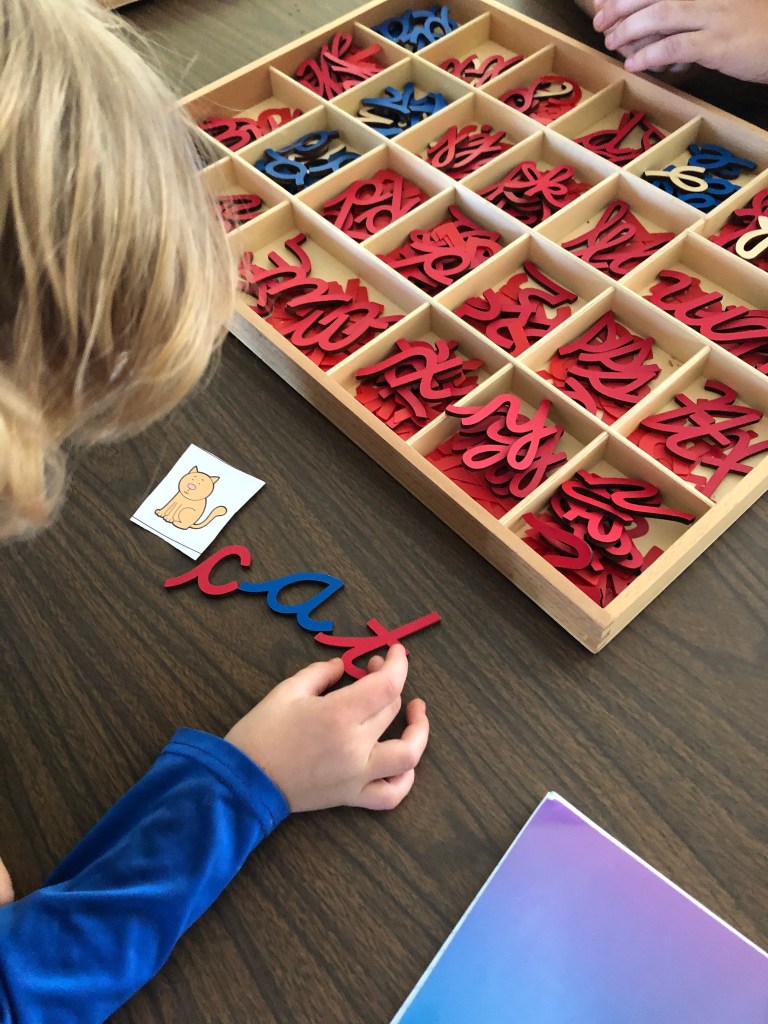
On-site instruction for elementary students is Montessori based, and includes morning meetings with a story and a three-hour work cycle. Our lower and upper elementary classes are separate, with ages 5-9 in lower elementary (grades K-3) and ages 9-12 in our upper elementary (grades 4-6). In 2026 our upper elementary students will be on site Tuesday-Friday, and lower elementary Wednesday-Friday, with an optional Tuesday for lower el students pending staffing.
Mornings begin with a group circle time, which is part of our strategy to build a strong classroom community. We always read or tell a story as part of this time, so that students can process ideas together. Our stories are intentionally very diverse, representing a broad range of experiences. We also focus on socio-emotional learning during this time.
During the work cycle, students follow their customized work plan, which has some work on it chosen by our guides, and other work on it chosen by the student. The child decides in what order to complete the work, and whether they prefer to do each work individually or collaboratively with another student.
Guides also present new work and concepts to students during this work cycle, with individual or small groups of students receiving presentations. This is how new skills are taught. This method allows students to receive new lessons as they are ready for them. It is particularly effective as we can watch for student interest in a certain topic, and then present related material. When students are interested in the topic, they learn more and retain it longer. Students are continuously engaged in chosen work, practice of previously introduced concepts, and presentations of new material.
Students work through progressions in math, science, ELA, and history. Students cycle through years focused on world geography and peoples of the world, the history of the universe, ancient world history, and Indigenous history in the Americas. Our science curriculum integrates all strands of science and moves students forward in a logical progression, building on previously learned concepts each time. The same is true for our math and our language progressions.
What does off-site elementary instruction look like?
Elementary off-site instruction varies by family, because we view caregivers as an integral part of their student’s education. It is most important to us that our elementary students have time on off-site days for extensive reading, playing and exploring outside, and building strong relationships with caregivers.
We encourage all families to use the public library, making weekly trips to allow students to choose any books they like for weekly free reading. One of the strongest predictors of academic success is a love of reading, so we want to work hard to develop that in our students. We ask all students to use their reading journals on off-site days to record titles/authors of books they are reading and write reading responses.
We send take-home bags with students each week with work that practices and extends their skills in work we have done on site that week, as well as additional books to be read both independently and with caregivers. Upper elementary students may also have access to a digital classroom with links to relevant videos and project ideas based on what we are studying at school.
What curriculum do you use?
The most basic answer is that we use whatever works best for the child! We use many traditional Montessori presentations for math and language, as well as the Great Lessons that introduce all of the subject areas. We also frequently draw from resources such as Words Their Way, UFLI Foundations, Logic of English, Building Foundations of Scientific Understanding, Singapore Primary Math, Beast Academy, Curiosity Chronicles, Structured Word Inquiry, and Deep Space Sparkle Art. For families who wish to purchase curriculum to use off-site, we often recommend Torchlight, Build Your Library, and Blossom and Root.
Junior High Student Learning
What does on-site junior high instruction look like?
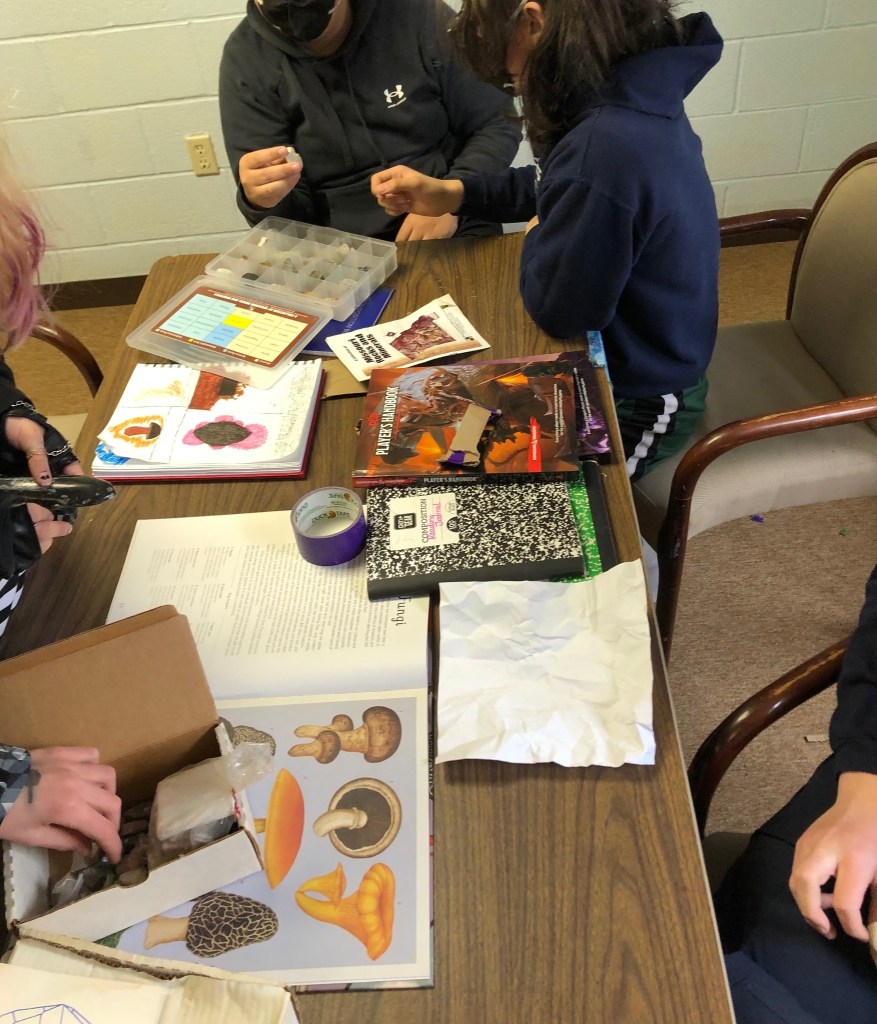
Our 7th-9th grade students are in our junior high classroom, and begin each day with a three-hour work cycle. During this time they have a variety of work both assigned by guides and self-chosen, generally consisting of projects. Students are able to choose the order in which they want to do their work, and if they want to complete it on their own or with another student. Small group and some whole group lessons and discussions are also held during this time. Students are expected to record their work in their work journals each day.
Students work through progressions of math and ELA skills at their own pace, similar to the way they work in the elementary classrooms. Our Montessori math progression takes them through pre-algebra, and then they are ready to begin Algebra I, which most students do in the Junior High class. Science continues to be integrated, connecting physics, chemistry, and biology in a solid foundation for more advanced study in high school. By 9th grade, students are in their first high school credit science, which is Conceptual Physics. Our ELA work focuses on fluent reading, introductions to engaging and globally important texts, and scientific word study that integrates vocabulary expansion and spelling work while studying word morphology and etymology. We also explore grammar and relate it to our writing, emphasizing learning various sentence structures.
In history, students cycle through years focused on Ancient World History, World History from 500-1500, and the History of the Americas (both North and South America) to 1800. In class, we work together on learning the skills of historical thinking and writing, participate in group discussions, and do learning activities such as historical simulations.
We link literature to our historical studies, reading texts such as The Epic of Gilgamesh, the Ramayana, the Odyssey, the Mahabharata, the Popol Vuh, and a variety of modern books linked to our historical era in some way. With these texts we focus on processing the texts such that we understand their meaning in its context, and pull out the universal themes that have made these texts popular well beyond their initial time and place. We integrate writing activities with our literature and historical studies, and also across the curriculum.
What does off-site junior high instruction look like?
Off-site work for 7th-9th grade students is shared each week in a Canvas classroom. The expectations for ninth grade work are higher, and result in high school credits. Students read their assignments in Canvas, and then do their work in their off-site work notebook, which the lead guide reviews and gives feedback on each week.
One ever-present part of their off-site work is independent reading. We encourage frequent trips to the local library and also work to stock our school library with high-interest and diverse book options for students to choose from. We work to develop a culture of reading among our students, so that they are always conversing about what they are reading. We know that students who are most successful and able to integrate new information are those who have read extensively!
Students are expected to plan their time such that they are able to complete all of their off-site work before Tuesday. We guide them through learning organizational and time-management strategies that will make this possible for them. They learn to become self-motivated learners and workers, and this is one of the primary benefits of our hybrid system. We also expect that they will engage in self care to protect their mental health during off-site time.
Ninth graders will keep portfolios of their work throughout the semester to present at the end of the semester, when they will share their learning in each subject with guides and collaboratively determine a letter grade for that subject for their high school transcript. This process is as low stress as we can make it, but serves as additional accountability for completing off-site work and showing that they have learned new material and skills throughout the semester.
High School Student Learning
First: Why high school at Prairie Song?
Prairie Song is a microschool, so the high school class is never going to be large. This means we’re consistently able to offer a small, personalized learning environment with a unique curriculum sequence in a supportive atmosphere. Our academic program shines; we’re able to fully integrate our English language and history instruction, and make frequent connections between these and math and science, too! All of your learning feels connected and purposeful at Prairie Song.
Our science sequence is physics-first, which you won’t find anywhere else around. The general sequence for Missouri schools is physical science, biology, and then chemistry. We do algebra-based physics first, because a basic understanding of chemistry relies on basic principles of physics…and basic biology relies on basic chemistry! Biology teachers and texts always have to do a crash course in chemistry first before beginning biology; we don’t! Our students who came up through elementary and junior high also already have a firm foundation in all of these areas of science before they start high school level science at all!
Our history program is also unique; between junior high and high school students will do three years of world history and two years of history of the Americas (both North and South!), plus a history elective. The traditional sequence in Missouri only allows two years of United States history, one year of world history, and one of government. We weave government content into our Americas sequence, and are able to give students a better and broader view of the world thanks to our history sequence, which we constantly connect to current events as well.
Our classes are taught at honors level by default, leaving room for students to do less and still be successful, while always encouraging them to push and stretch themselves. We also recognize that they are often able to push themselves more at certain points of the year than others, and we’re flexible enough to allow for that!
If you value an environment with a small class of supportive students and guides, rigorous academic instruction with plenty of flexibility baked in, and a holistic instructional program in which making connections is the norm, you’ll love Prairie Song!
And if you want all of this but also want to participate in activities and sports at Kirksville High School, you can! You can attend KHS for the first two periods of the day and then come to Prairie Song. This makes you eligible for any school activity at KHS, from sports to clubs to theatre to dances.
And whether you’re attending KHS part time or not, you can graduate with the A+ program at Prairie Song, meaning that you’ll be able to access help paying for college! You can find all of the requirements for A+ and program benefits here.
What does on-site high school instruction look like?
Each semester our high school students have learning blocks for history, literature and language, science, math, project seminar, and an elective. Most of our learning blocks (except math) are 90-120 minutes long to allow students to fully engage in learning activities. We are also able to flex our schedule to accommodate activities that need extra time to complete.
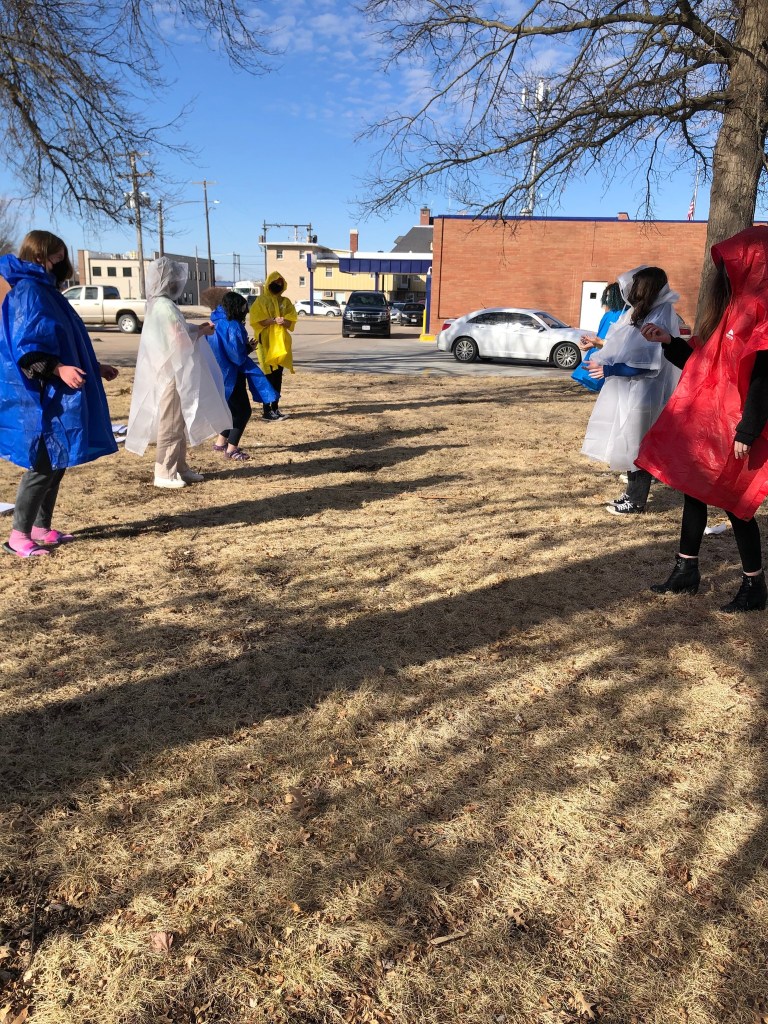
For history, we work together on learning the skills of historical thinking and writing, participate in group discussions, and do learning activities such as historical simulations. This semester students will be working to understand cause and effect relationships in events in the Americas and beyond during that time period; making historical comparisons between events and states in various areas of the world; identifying continuity and change in areas studied; contextualizing primary sources; and learning to conduct research and write academic essays. We also make frequent links between our studies and current events.
In literature and composition, we study a variety of texts and produce related writing. We integrate our work with our historical studies, concentrating on reading texts both from and inspired by our historical period, and including modern authors. We work on the skills of literary analysis, rhetorical analysis, argument, and synthesis. In the course of our high school years, we cover all of the AP standards for AP Literature and Composition as well as for AP Language.
We also ask all students to keep a reading journal to track their independent reading. We want independent reading to make up a significant portion of their work. They create individual reading goals that challenge them in some way, and choose books that will meet those goals. This allows students to read at a comfortable level for them, and cultivate a love of reading. Students share book recommendations with one another each week as well!
We have two science blocks per week. One is lab- and project-focused, and the other is conceptually driven. Both are as hands-on as possible, to make learning both fun and durable! We use high-level texts as bases for knowledge, and do additional work in class to ensure comprehension, understanding, and extension of the material. Students will be literate in physics, chemistry, and biology by the time they graduate from Prairie Song. We also encourage students to take a fourth science in their senior year at Truman State!
During each on-site day, we have a math block as well. Each student works on the math curriculum that best fits them, and guides provide introductions to new concepts and assign problem sets for students to complete. Students work on those sets and get help as needed, checking their answers as they go. They then complete an additional problem that guides check to see if the student is ready to move on to a new section or if we need to reteach the concept and complete additional practice first. We teach all concepts to mastery. Students work through Algebra I, then Geometry, followed by Algebra II, and then advanced math courses.
We also have math electives that include real-world project-based math with projects calculating the costs for solar panels and analyzing the benefits in various places in the United States, understanding the risks of texting while driving, speeding, mass incarceration, natural disasters, and the basics of using a bank account. Another math elective is an in-depth personal finance course to equip students to understand taxes, loans, and more!
Students have an elective each semester that vary based on student interest. Past electives have included art, intro to psychology, beginning German, film studies, and more!
The highlight of the curriculum at Prairie Song is project seminar. Students have one two-hour project seminar block per week in which they work on a variety of self-chosen projects, based on their own interests. They work independently or in small groups, according to their preferences. Student projects have included organizing bake sales, doing behavioral research on mice, writing and performing a murder mystery, and writing and directing a school play that was performed in the spring, a study on bats and making paintings of several bats, experimenting with a solar car, analyzing Fortnite playing, and planning a community run/walk to raise awareness about mental health struggles.
Writing is taught in all subject areas. We work on both academic and creative writing. We give our writing context so that assignments are meaningful to students. We share our writing with one another as well as beyond our classroom so that we are always accomplishing the primary purpose of writing: communication with others.
What does off-site high school instruction look like?
High schoolers have off-site work assigned through Canvas each week; we essentially engage in a flipped classroom model in which students do reading and watch relevant videos while off site to prepare for learning activities on site. They engage in discussions on Canvas and edit writing done in class or produce new writing of the same type modeled in class that week.
Students are expected to plan their time such that they are able to complete all of their off-site work by Tuesday morning. We guide them through learning organizational and time-management strategies that will make this possible for them. They learn to become self-motivated learners and workers, and this is one of the primary benefits of our hybrid system. We also expect that they will engage in self care to protect their mental health during off-site time.
 Prairie Song Academy